OpenAI and Anthropic Announce New Consulting Ventures
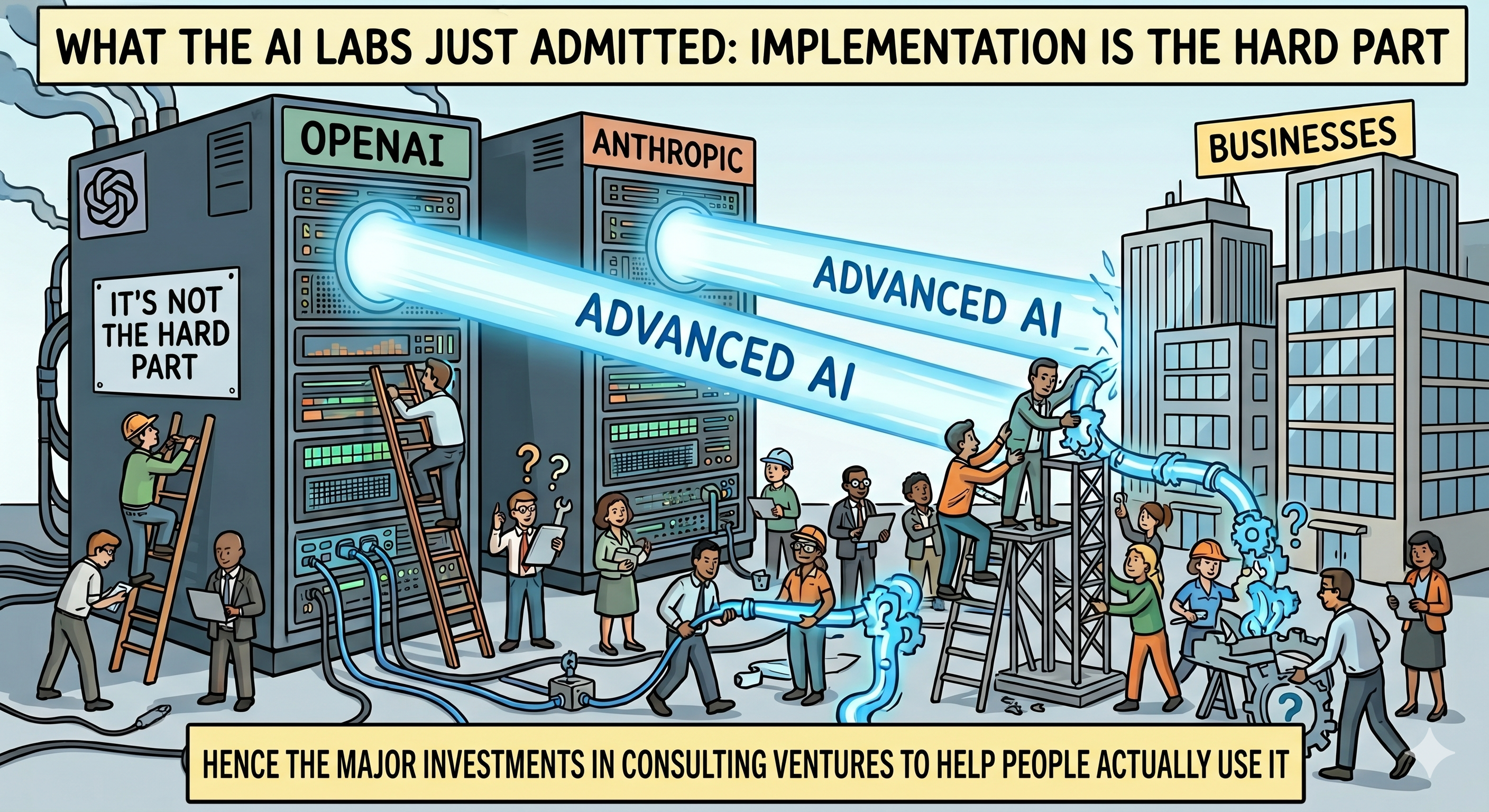
On the same day last week, OpenAI and Anthropic each announced a new consulting venture. OpenAI’s is backed by $4 billion from 19 private equity firms. Anthropic’s is a $1.5 billion partnership with Blackstone, Goldman Sachs, and Hellman and Friedman. Both are hiring what they call “forward-deployed engineers” to help businesses actually use AI.
Read that again. The companies that built the most advanced AI in the world just decided they need consultants to help people use it.
That is not a marketing move. That is a confession.
The Real Signal Here
For the last several years, the AI conversation has been dominated by model performance. Bigger context windows. Better reasoning. Faster inference. The assumption was that if the technology got good enough, adoption would follow.
It hasn’t. Not at scale.
Now the labs themselves are acknowledging what practitioners have been saying for a while: the technology is not the hard part. Implementation is.
Getting your people to trust it, preparing your data for it, defining the problems worth solving with it, building the governance that keeps it safe, and none of that comes with the model.
This is exactly the situation I have spent 30 years solving for organizations. It’s how to extract real value from technology, first in data and analytics, now in AI. It’s rarely that the technology isn’t good enough, it’s the underlying architecture and yes, the people involved.
What You’re Actually Buying
Let’s be precise about what these new ventures are and are not.
Both ventures are explicitly targeting mid-sized businesses - companies that have been priced out of Big Three consulting and lack the in-house AI talent to go it alone. That is the right problem to identify.
But there are real constraints on how they will solve it. Their initial client pipeline runs through their PE backers’ portfolio companies. Access is not open to any growing business that wants it. You need to be in the right portfolio to get the call.
And when they do show up, they are bringing model-specific engineers, not organizational change management. Keep that distinction in mind as you read the rest of this.
What a Forward-Deployed Engineer Actually Does
The term comes from Palantir, which pioneered the model years ago. The idea is straightforward: instead of handing a client software and a manual, you embed engineers directly inside the business. They learn the workflows, identify where the technology fits, build the integrations, and train the team on the specific tool.
It works. For large-scale technical deployments, having that kind of hands-on support is genuinely valuable.
But notice what it is and is not. A forward-deployed engineer is an expert in the model. They are there to make that model work inside your organization. They are not there to question whether the model is the right answer. They are not governance specialists. They are not organizational change consultants. They are not going to recommend a competitor’s tool if it happens to fit your problem better.
That is not a criticism. It is just what they are. Understanding the difference matters when you are deciding what kind of help your organization actually needs.
Why Vendor-Neutral Advice Is Harder to Find Than It Sounds
Both of these ventures have a structural dynamic worth understanding. They are funded by private equity firms whose returns depend, in part, on accelerating AI adoption. That does not make their advice dishonest. It does mean every recommendation they make is filtered through a specific lens.
Vendor-neutral advice means being willing to tell a client that AI is the wrong solution for a particular problem. It means recommending a different tool when a different tool fits better. It means telling an organization to slow down and fix its data before deploying anything, even when the client is eager to move fast.
That kind of advice is harder to deliver when you are funded to accelerate adoption of a specific technology. It is also harder to deliver when your implementation fees depend on a project moving forward.
This is not unique to these ventures. It is a systemic issue in the consulting industry. The firms best positioned to give you truly independent advice are the ones who do not have a financial stake in which technology you choose. That is a short list, and it is worth knowing who is on it before you bring anyone in.
What Most AI Programs Actually Skip
Most organizations roll out prompt training, hand out a ChatGPT license, and call it an AI program. That covers maybe ten percent of what a real adoption effort requires.
They need someone to help them identify real problems worth solving, not AI use cases retrofitted to existing workflows. They need governance and policy frameworks that their teams will actually follow. They need the organizational literacy to evaluate AI results critically, not just accept outputs. And they need a structured process that can be repeated across teams without depending on one expert who might leave.
Can you do this yourself? Of course you can, if you invest the time and effort. But studies have shown that companies are much more successful bringing in outside help to lead or jumpstart these efforts. Whether you bring in RBK Strategic Consultants, or another company, make sure they use a structured, people-centered method for AI adoption. Not a technology solution, but a system for building the context, alignment, and governance that makes AI work in practice. It’s been delivered to organizations ranging from small teams to large enterprises, and the pattern is consistent: teams move faster, waste less effort, and build solutions that hold up over time.
What to Ask Before You Bring Anyone In
Whether you work with RBK Strategic Consultants or someone else, here are the questions worth asking before you sign anything.
Do they work with multiple platforms, or are they tied to one vendor? If they only sell one model, they will only solve for that model.
Will they tell you if AI is the wrong solution for a specific problem? If the answer is vague, that is your answer.
Do they have a governance and policy framework, or just implementation capability? Deploying AI without governance is how organizations end up with liability they did not anticipate.
How do they handle workforce readiness? Technology does not fail at the technical level. It fails when the people using it do not trust it, do not understand it, or were never given the context to use it well.
What does success look like beyond go-live? A lot of AI projects get deployed and then quietly stopped. Ask what their definition of a successful engagement is, and whether they measure it.
Any credible AI partner should be able to answer these directly. If they cannot, keep looking.
What This Means for Your Business
The labs validating AI consulting as a multi-billion-dollar market is useful information. It tells you that the implementation gap is real and that even the best-resourced organizations in the world have not closed it yet.
It also tells you something about timing. The organizations that build structured AI programs now, while others are still experimenting, will carry a durable advantage. They will not be starting over in two years when the model landscape shifts again.
The right question is not which AI to use. It is whether your organization has the structure, the context, and the governance to use any AI effectively.
If you are not sure where you stand, that is what our AI Readiness Assessment is designed to answer. It evaluates your organization across six dimensions, and each one matters for a different reason.
Current AI Exposure evaluates your starting point, where your organization already uses AI and what is actually working.
Culture and change readiness tells you whether your teams are positioned to actually adopt new ways of working, or whether you are about to deploy technology into an organization that will route around it.
Data readiness tells you whether your information is clean, accessible, and structured well enough to support AI reliably. Most organizations are surprised by what they find here.
Business application and strategic impact identifies where AI can create real, measurable value in your specific operations, not generic use cases borrowed from a different industry.
Responsible AI and risk management addresses governance, ethics, and the guardrails your organization needs before it scales anything.
Governance and leadership alignment ensures that the people making decisions about AI are working from a shared understanding of the goals, the risks, and the criteria for success.
The output is a scored assessment, a prioritized opportunity map, and a concrete set of recommendations for where to focus first.
The labs just confirmed the problem. The question is whether your organization is ready to solve it.
If you would like to find out more, schedule a complimentary discovery call.