Who’s in, who’s out, and what that tells you about Responsible AI
The headline last week was about which AI companies won classified Pentagon contracts. That is not the interesting story.
The interesting story is what those companies agreed to, and what one company refused.
The deal
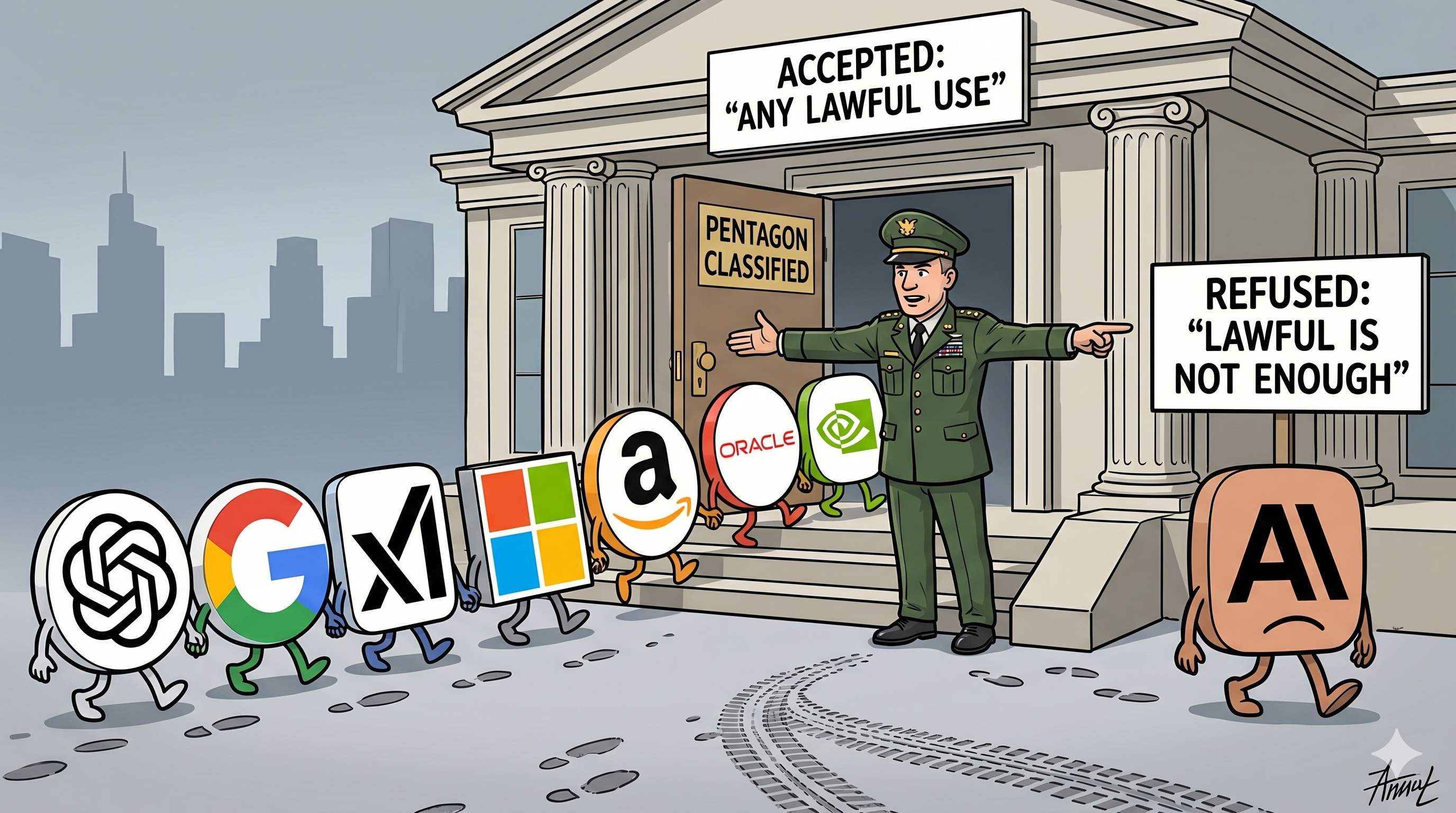
On May 1, the Department of War announced classified AI agreements with eight companies: OpenAI, Google, xAI, Microsoft, Amazon Web Services, Oracle, Nvidia, and a startup called Reflection AI. These agreements give all eight access to the Pentagon’s most classified networks. In exchange, each company agreed that its AI could be used for any “lawful operational use” the military deems appropriate.
That phrase, “any lawful operational use,” is worth pausing on.
Lawful is not the same as ethical. What is legally permissible shifts over time, across administrations, and through court decisions. When a company agrees to any lawful use, it is not agreeing to a fixed set of rules. It is agreeing to whatever the government determines is permissible at any given moment. That gap between lawful and ethical is where this story lives.
The two lines Anthropic would not cross
Anthropic, the company behind Claude, was not on the original list. They were excluded because they refused to accept “any lawful use” without limits. Specifically, Anthropic asked for two contractual carveouts.
The first was that Claude could not be used for mass domestic surveillance of American citizens. This sounds obvious. It is less obvious than it appears. Some forms of mass surveillance of Americans do not violate the Fourth Amendment. Open-source collection and the third-party doctrine sometimes allow the government to gather significant information without a warrant. Anthropic was not asking the Pentagon to stay within the law. They were asking for a higher standard than the law currently requires. The Pentagon refused to write that into a contract.
The second condition was that Claude could not be used to power fully autonomous weapons with no human in the targeting loop. I think about this one quite a bit. There is a reasonable case for defensive autonomous systems, ones that can respond to incoming threats faster than any human can react. My concern is offensive capability. The decision to take a human life is among the most serious a government or military can make. Delegating that decision to an algorithm feels like a moral failure to me. That is my view, not a universal one.
For both conditions, the Pentagon’s response was the same: we agree to lawful. We will not put anything more than that in writing. Anthropic’s response was: lawful is not enough. And that position cost them the contract. This doesn’t mean that Anthropic is above reproach. I know authors who are part of a settlement against them for illegally training models on their books.
Not all eight are the same kind of company
It is worth being precise about the eight companies, because they are not all doing the same thing.
Three are model providers, the companies actually building the AI: OpenAI, Google, and xAI. Reflection AI sits here too. Three are infrastructure and cloud providers: Microsoft, AWS, and Oracle. Their inclusion reflects a separate procurement decision about which platforms host the classified workloads. One is a chip company, Nvidia. AI runs on Nvidia hardware.
When coverage describes Anthropic as being shut out of a deal with “AI companies,” that framing overstates the competition. Anthropic was excluded from the model provider tier specifically. The DoD assembled the full stack, chips, cloud, and models, and at the model layer, they chose companies willing to agree to unlimited lawful use over one that drew specific lines in writing.
The most interesting name on the list
The most surprising name is one most people have not heard of: Reflection AI.
Reflection was founded in 2024 by two former DeepMind researchers. Misha Laskin led reward modeling on Google’s Gemini project. Ioannis Antonoglou co-created AlphaGo. The company raised $2 billion in October 2025 at an $8 billion valuation. Its stated mission is to be America’s open-source challenger to DeepSeek.
As of this writing, Reflection has not shipped a product.
One of their backers is 1789 Capital, a venture firm where Donald Trump Jr. is a partner. They put $100 million into Reflection’s October 2025 round.
I am not drawing a direct line between that investment and this contract. I do not know that one exists. What I do know is that a well-funded startup with no shipped product was included in a classified DoD AI agreement, while a company with a deployed, capable model was excluded for asking that its AI not be used to surveil Americans or power autonomous weapons. I will let you draw your own conclusions from that.
One more absence worth mentioning
One other name is missing from the list: Meta, which builds the Llama family of open-source models. I do not have a clear answer for why. It may reflect licensing complications in classified environments, or something about Meta’s current relationship with the administration. I genuinely do not know, and I am not going to speculate beyond that.
What this means for your organization
Most organizations reading this are not buying classified military AI. But the logic applies directly to enterprise procurement.
When you select an AI vendor, you are not just choosing a capability. You are inheriting that vendor’s ethical commitments, and their ethical concessions. The companies that signed this agreement agreed their AI can be used for any purpose the government deems lawful. That is a policy position. It reflects how those companies think about the relationship between their technology and its uses.
Anthropic drew specific lines, in writing, before handing over access. That position cost them a major contract.
The question for your organization is not whether you trust the Pentagon’s judgment. The question is what standard you want your AI vendor to hold itself to, and whether that standard is written down anywhere.
Lawful and ethical are not the same thing. The AI partners worth trusting already know that.