The Redesign Gap: Why AI Is Making Your Teams Busier, Not Better
Harvard Business Review published a field study this year that should bother every executive who signed an AI contract. Researchers spent eight months inside a 200-person tech company, watching what AI actually did to the work. The work did not shrink. It grew.
Three patterns emerged. Capacity that AI freed up filled again almost immediately. Work bled across time boundaries, because tasks that are easy to start get started at 9 pm. People ran more parallel threads, splitting attention across more work rather than finishing less of it. And the sharpest cost landed at the bottom of the org chart, where the starter tasks that train new professionals quietly disappeared.
The researchers presented these findings as a surprise. They should not surprise anyone. They are the predictable result of how most companies roll out AI.
In an earlier piece, The Context Gap, I argued that AI stalls on the front line because the context it needs lives inside your organization and never reaches the model. This piece is about the next chapter: what happens when you roll AI out anyway, without changing how the work itself is designed.
The Adoption Numbers Tell the Same Story
A recent Gallup survey puts hard numbers on how shallow AI adoption still is. Frequent use, meaning a few times a week or more, stands at just 26% of U.S. workers. Daily use is 12%. Nearly half of the workforce, 49%, says they never use AI in their role at all. Total use was flat for the quarter, even as headlines suggest AI is everywhere.
The leadership gap keeps widening. In the latest quarter, 69% of leaders reported using AI, compared with 40% of individual contributors. Frequent use among leaders has climbed from 17% to 44% since 2023. Among contributors, it moved from 9% to 23%. Every quarter, the people closest to the operational work fall further behind the people furthest from it.
Gallup also names the most common barrier to individual AI use, and it is not resistance or fear. It is lack of utility. Employees are not refusing to use AI. They tried it, and it did not help them do their jobs. Then they went back to work.
Put the two studies side by side and the picture is uncomfortable. Where AI is used, it intensifies work rather than reducing it. Where it is not used, the reason is that it offers nothing useful. Both problems trace back to the same root.
A Playbook Built for the Corner Office
Consider the standard rollout playbook. Buy licenses. Run a kickoff demo. Track logins. Hope.
Nobody designed that playbook badly on purpose. It simply formed around the experience of the people who approved the purchase. A leader opens a model and asks for a competitive summary, a market analysis, or a draft board update. The output is good, because the model was trained on exactly that kind of public, external material. The tool proves itself at the top, and the rollout assumes everyone else will find their own value the same way.
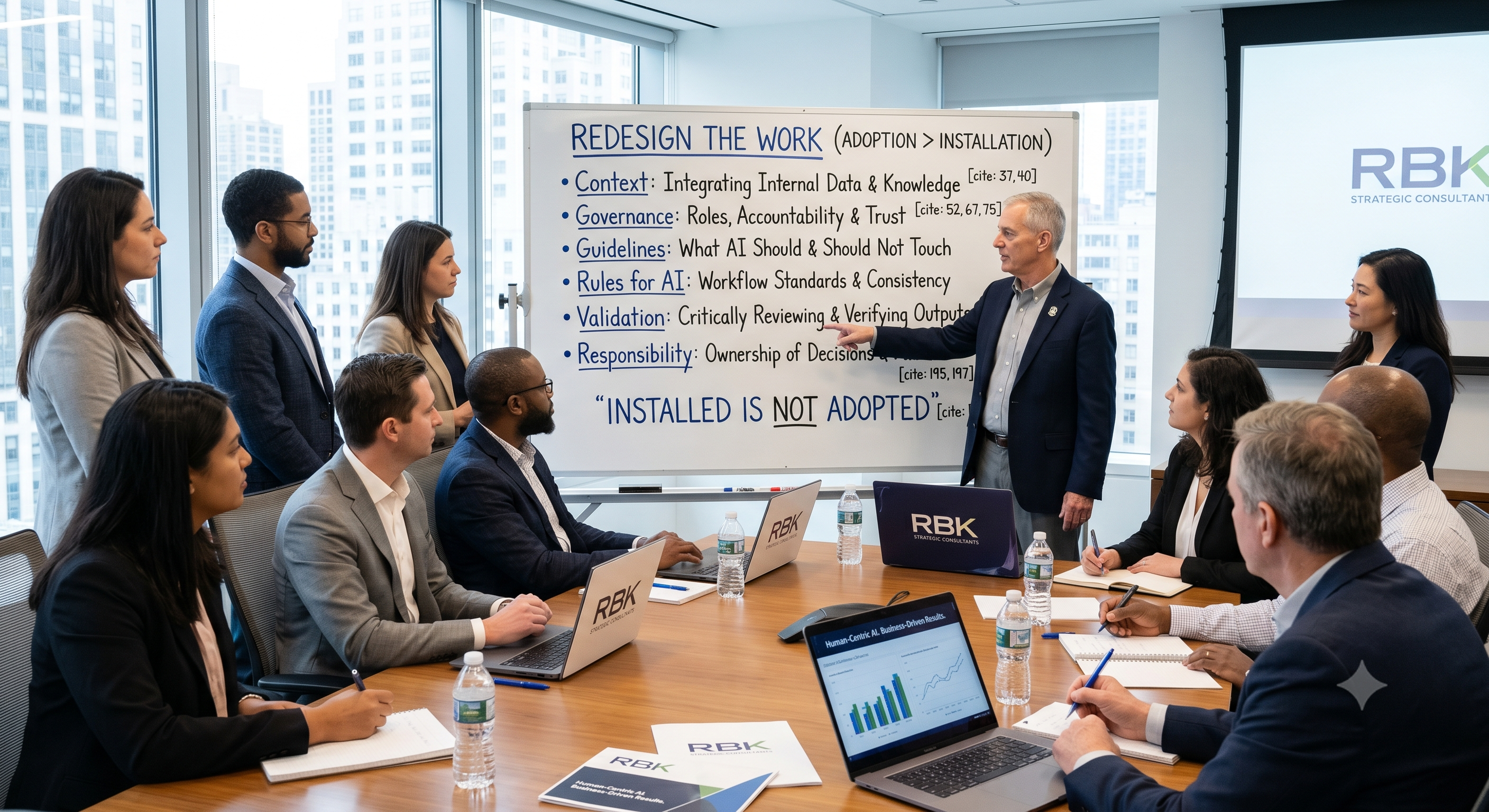
The playbook is what fails from there, because a contributor’s job is nothing like that. A contributor’s value comes from executing reliably inside your company’s specific rules, workflows, and exceptions. For AI to help with that work, contributors need five things leaders never needed:
Training that goes deeper than a lunch-and-learn, aimed at their actual tasks. Shared context, so the model knows how your company works instead of how the internet works. Clear guidance on which tasks AI should and should not touch. Consistent standards, so two people doing the same task get comparable results. And governance, so everyone knows what is allowed, what gets reviewed, and who is accountable for the output.
Most rollouts provide none of these. Then they call the result a usage problem and schedule another demo.
Skip the foundation and the HBR result is what you get. AI shaves minutes off individual tasks while the surrounding job keeps its old shape. The minutes scatter. The threads multiply. The work intensifies. Nobody can point to where the gain went, because nobody ever decided where it should go.
Redesign Is a Decision, Not a Side Effect
Freed capacity refills by default. That is what the HBR study documents. The only question is whether it refills with intent.
If AI cuts three hours from a weekly reporting cycle, someone has to decide what those three hours become. More client time? Deeper analysis? A shorter week for an overloaded team? Left undecided, the hours dissolve into more email, more threads, and more half-finished tasks. The company pays for the tool and receives motion instead of capacity.
Redesign also means deciding which tasks should disappear entirely, not just go faster. A report that AI can produce in minutes might be a report nobody should produce at all. The rollout that never asks this question automates waste and calls it productivity.
Then there is the question almost nobody is budgeting for. Starter tasks, the first drafts, the data pulls, the meeting summaries, were never just output. They were the training ground for your next generation of senior people. When AI absorbs them, the bottom rung of the ladder comes off. If you do not deliberately design what develops junior talent now, you will have AI doing the junior work in five years and nobody ready for the senior work.
None of this is a technology decision. All of it is a management decision. That is precisely why it gets skipped: the technology arrives with a budget and an owner, and the redesign arrives with neither.
Installed Is Not Adopted
The companies getting real returns from AI are not the ones with the most licenses. They are the ones that treated the rollout as the starting line and did the unglamorous work after it: redesigning roles, building shared context, setting standards, and deciding on purpose where the recovered capacity goes.
If AI made your team busier, you did not adopt it. You installed it. The difference between those two words is all the work most rollouts skip.
Sources: Harvard Business Review, “AI Doesn’t Reduce Work, It Intensifies It” (February 2026); Gallup, “Frequent Use of AI in the Workplace Continued to Rise in Q4” (January 2026); RBK Strategic Consultants, “The Context Gap” (April 2026).