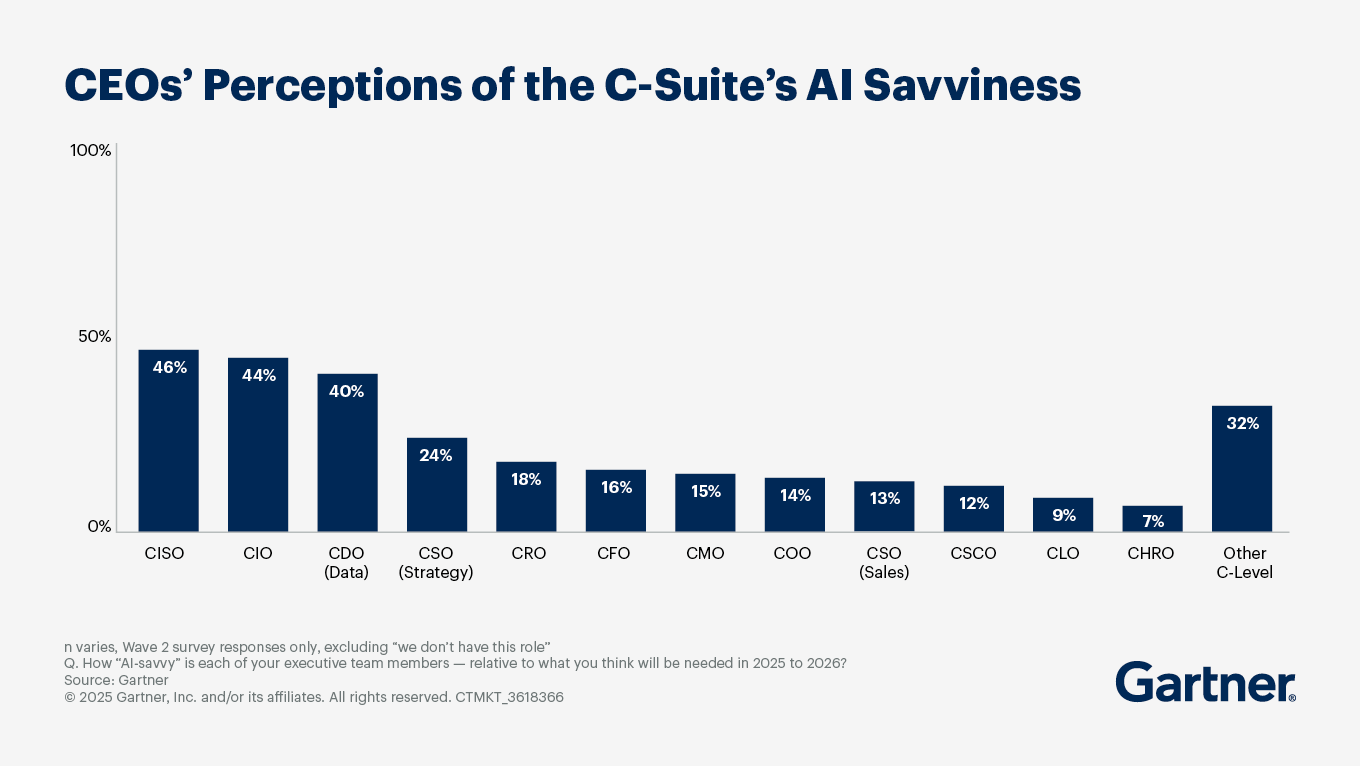
Only 44% of CEOs are confident their CIO can deliver on AI.
That number comes from Gartner. And if you are a CEO, it should make you stop and think, not about your CIO, but about the function that most growing companies do not have at all.
What Is the Real Problem Here?
Gartner’s research describes a widening gap between what CEOs expect from AI and what their technology leaders are equipped to deliver. CEOs increasingly see AI as a business transformation enabler. They want it to reshape operating models, improve how decisions get made, and create new competitive advantages. That is a business strategy problem, not a technology problem.
Most CIOs are exceptional at what they were hired to do: managing infrastructure, delivering systems, and keeping the lights on. That skill set is valuable and irreplaceable. But leading an AI transformation that touches every function, every team, and every business process is a different job. It requires a different lens.
This is not a knock on CIOs. It is an honest description of a gap that has emerged quickly, and one that most organizations have not yet figured out how to close.
Only More So
Here is how I think about AI relative to every other technology a company has ever adopted.
To paraphrase a classic Humphrey Bogart movie line: it is a technology just like any other technology, only more so. (Extra points if you know the reference, below.)
That framing matters. AI is not magic. It does not get a pass on the fundamentals. Like any other significant technology, it must be managed thoughtfully, with appropriate training, clear expectations, honest validation, and real value metrics. The principles that made enterprise technology work over the past three decades still apply.
The more so is what catches organizations off guard. The speed of change is faster. The scope of impact is wider. The governance requirements are more complex. The margin for error is smaller. When those factors converge, you need more of everything: more structure, more oversight, more deliberate change management.
That is exactly what most growing companies are not resourced to provide.
The Role That Most Growing Companies Do Not Have
Fortune 500 companies are standing up Chief AI Officer roles. They recognize that AI strategy requires dedicated senior leadership, someone whose entire focus is on aligning AI initiatives with business priorities, building internal capability, and ensuring responsible deployment.
The other 66 percent of CEOs who told Gartner they do not yet have an operating model fit for an AI-driven world are mostly navigating without that function. They are asking their CIO to do two jobs. Or they are asking business unit leaders to figure it out on their own. Or they are doing nothing and hoping the gap closes itself.
It does not close itself.
A Complement, Not a Replacement
This is where the concept of a Fractional Chief AI Officer becomes practical.
A fractional CAIO is not a replacement for your CIO. The CIO role is critical, and a good technology leader is an asset in any AI program. The fractional CAIO works alongside the CIO, filling the strategic and operational gap that exists between technology delivery and business transformation.
Think of it this way. The CIO answers the question: can we build it, run it, and secure it? The CAIO answers the question: should we build it, what do we do with it, and how do we make it work for our people and our strategy?
Those are two different questions. Growing companies need both answers.
A fractional model makes this accessible without the cost or commitment of a full-time executive hire. You get senior AI leadership applied to your specific context, for as long as you need it. The goal is not to create dependence. The goal is to close the gap, build internal capability, and make your existing leadership team more effective.
Done right, it makes your CIO look good. It gives your CEO confidence. And it gives your organization a clear path from experimentation to real business value.
Your Number
Gartner found that 44% of CEOs are confident in their CIO’s AI readiness.
The more useful question for any CEO is not what the average is. It is: How confident are you?
If you have not had a direct, honest conversation about the gap between your AI ambitions and your current leadership capacity, that conversation is overdue. Not because your people are failing, but because the gap is real, it is common, and it is solvable.
You do not have to figure it out alone. That is exactly what a Fractional AI partner is for.